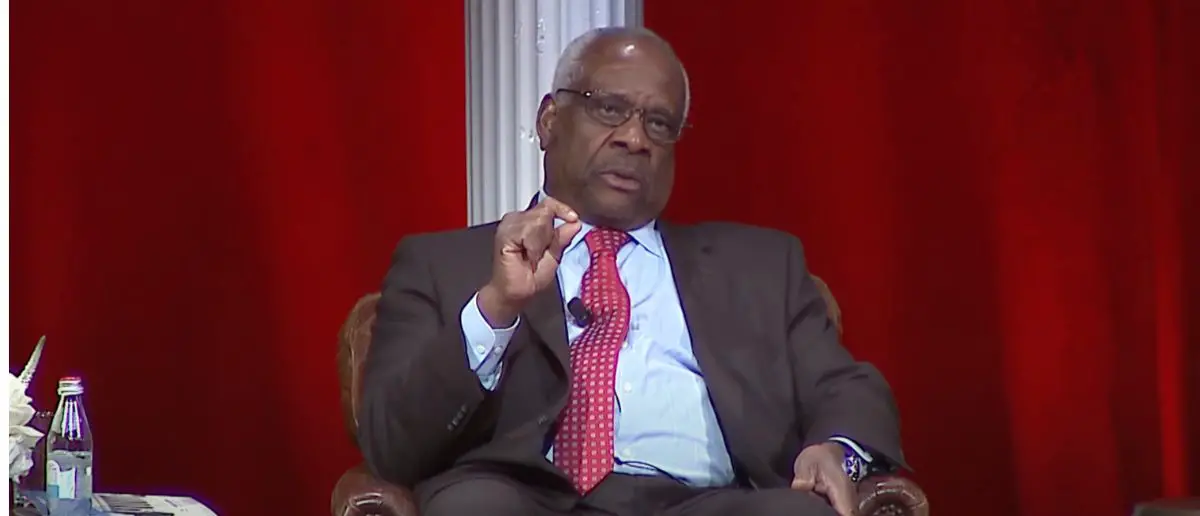
Thomas is one of the best Supreme Court justices we have. He’s not afraid to stand strong for what’s right.
And Clarence Thomas fired back at an attorney during a heated court case.
Supreme Court Justice Clarence Thomas exposed the New Jersey Attorney General’s office for launching a blatant “fishing expedition” against a pro-life group, all without a single complaint to back it up. This revelation came during oral arguments in a case that’s become a battleground for free speech and religious freedom.
Thomas zeroed in on the probe targeting First Choice Women’s Resource Centers, a faith-driven nonprofit operating five centers in New Jersey that helps women choose life over abortion. The justice grilled Chief Counsel Sundeep Iyer, demanding to know the real motive behind the aggressive subpoena.
“You had no basis to think that they were deceiving any of their contributors?” Thomas pressed, cutting straight to the heart of the matter.
Iyer tried to dodge, mentioning vague gripes about other crisis pregnancy centers, but he finally confessed that none pointed directly at First Choice.
“We had no complaints,” Iyer admitted. “But state governments, [the] federal government, initiate investigations all the time in the absence of complaints where they have a reason to suspect that there could be potential issues of legal compliance.”
He doubled down, claiming they had plenty of grounds based on worries over donor deception, unlicensed medicine, privacy breaches, and false medical claims.
“Well, that just seems a burdensome way to find out whether someone has a confusing website,” Thomas shot back.
The controversy stems from a 2023 subpoena issued by AG Matthew Platkin, demanding First Choice hand over donor names under suspicions of fraud. This move reeks of intimidation tactics aimed at crippling a group that stands against the abortion industry.
First Choice fought back with a lawsuit, charging that the demand violates their First Amendment protections.
Platkin’s lawyers argued that no actual handover of names was required yet, but many of the justices weren’t buying it, seeing through the weak defense.
“You don’t think it might have an effect on future potential donors to the organization to know that their name, phone number, address, etc, could be disclosed as a result of the subpoena?” Chief Justice John Roberts challenged Iyer, exposing the real-world harm.
Iyer brushed it off, saying it wouldn’t matter, and nitpicked a donor’s statement as merely “backwards-looking” because of its wording: they would have been less “likely to donate … if we had known information about the donation might be disclosed.”
“Really? I mean, we’re going to now pick over the tense of the verb that they chose?” Justice Neil Gorsuch fired back in disbelief, calling out the absurdity.
On the other side, First Choice’s lawyer Erin Hawley drove home how even modest donors could be deterred by such heavy-handed government scrutiny.
“If you look at the allegations in this case, some donors gave as little as $10,” she pointed out. “Those folks are going to be worried about a state attorney general getting their names, phone numbers, addresses, places of employment, so that he can contact them about a donor website.”
Iyer attempted to downplay the subpoena as just an “administrative” one, not like a grand jury demand, insisting it doesn’t force compliance and courts nationwide agree.
“An administrative subpoena is very different, and courts, as a matter of state law, have held across the country that the subpoenas themselves don’t impose any obligation to produce documents,” he argued.
Hawley wasn’t having it, stressing that the document’s language screams coercion, threatening licenses or contempt charges. “That’s not what the face of the subpoena says,” she countered. “It says command or else we’ll possibly go after your business license, or you’ll wind up [being charged] with contempt. Those are the death knell for nonprofits like First Choice.”
Surprisingly, liberal Justice Elena Kagan showed some understanding for the pro-life side’s fears. “An ordinary person, one of the funders for this organization or for any similar organization, [who is] presented with the subpoena and then told, ‘But don’t worry, it has to be stamped by a court,’ is not going to take that as very reassuring,” she remarked.
This case spotlights the dangers of Democrat-led states weaponizing their power against conservative causes, especially those defending the unborn.